

There’s a field of science that has been running quietly for forty years, that almost nobody outside it has heard of, and that I fell into completely by accident.
It’s called Artificial Life. And once you understand the question it’s asking, you can’t unsee it.
Here’s the cleanest way I know to explain the difference.
Artificial Intelligence asks: can we build something that solves problems the way a mind does? Recognise a face. Translate a sentence. Win at Go. The benchmark is competence.
Artificial Life asks something much stranger: what is the minimum recipe for something to be alive (or lifelike) at all? Not smart. Not useful. Just… alive. Self-maintaining. Self-replicating. Adaptive. Autonomous.
AI studies intelligence-as-we-know-it. ALife studies life as it could be, and that phrase, which comes from the field’s founding literature, is the whole thesis in four words.
The field got its name in a room in New Mexico
The discipline was named by an American computer scientist called Christopher Langton in 1986, and it properly began in 1987 when he organised the first Interdisciplinary Workshop on the Synthesis and Simulation of Living Systems at Los Alamos National Laboratory.
The guest list is the best evidence of what the field is. Langton invited chemists, biologists, computer scientists, mathematicians, materials scientists, philosophers, roboticists and computer animators. All of them had been circling the same set of questions in isolation, inside disciplines that had no room for them. Langton’s real contribution wasn’t a technique. It was giving a scattered group of people a name to gather under.
His definition was elegantly simple: the study of artificial systems that display the behaviour of natural living systems.
The intellectual roots go back further: John von Neumann and Stanislaw Ulam were working on self-replicating machines in the 1940s, decades before anyone called it ALife. And the impulse is older than any of it. Every culture has a Golem story: the fantasy of matter waking up.
The field splits into three flavours, named for what they’re made of:
- Soft ALife: life-like behaviour in software.
- Hard ALife: life-like behaviour in hardware. Robots.
- Wet ALife: life-like behaviour built from actual chemistry, in a lab.
Let me show you one of each, because the examples are far more interesting than the taxonomy.
Soft: two of the most consequential toys ever built
The Game of Life
In October 1970, Martin Gardner used his Scientific American column to describe a “solitaire game” invented by the mathematician John Horton Conway. It became one of the most famous columns in the magazine’s history.
The rules fit in a tweet. You have a grid. Each cell is alive or dead. Each step, every cell looks at its eight neighbours:
- A live cell with two or three live neighbours survives.
- A dead cell with exactly three live neighbours becomes alive.
- Everything else dies or stays dead.
That’s it. No physics, no randomness, no goals. And out of those three rules come structures that genuinely astonish people the first time they see them: blinkers that oscillate forever, gliders that walk diagonally across the grid, glider guns that manufacture a stream of gliders indefinitely.
Then it gets properly strange. The Game of Life was later shown to be Turing complete. Which means: inside this three-rule grid, you can build a universal computer. Anything your laptop can compute, a sufficiently large and cleverly arranged pattern of dots turning on and off can also compute.
Sit with the implication. Nobody designed a computer into those rules. Nobody designed a glider. They were found, by people playing. Complexity was hiding inside simplicity, waiting.
Boids
In 1987, a computer graphics researcher named Craig Reynolds published “Flocks, Herds, and Schools: A Distributed Behavioral Model” at SIGGRAPH. He wanted to animate a flock of birds without hand-drawing every bird.
His solution, boids (from “bird-oid objects”), gave each simulated bird three rules based only on the neighbours it could see:
- Separation: don’t crowd your neighbours.
- Alignment: steer toward the average heading of your neighbours.
- Cohesion: steer toward the average position of your neighbours.
No leader. No plan. No bird knows what the flock is doing. And yet the flock does that liquid, wheeling, unmistakably alive thing that murmurations do. Remove any one rule and it collapses: without separation they clump into a blob, without alignment they scatter, without cohesion they drift apart.
Reynolds’s model was first used in film in Tim Burton’s Batman Returns in 1992, for the bat swarms and the marching penguins. He later received an Academy Scientific and Engineering Award for the work.
The deep result isn’t the birds. It’s this: global coordination does not require global knowledge. That single sentence is now load-bearing in swarm robotics, distributed systems, traffic modelling, crowd simulation and multi-agent AI.
Wet: the most humbling number in biology
Now the version made of actual matter.
In 2016, researchers at the J. Craig Venter Institute announced JCVI-syn3.0, a synthetic bacterial cell with the smallest genome of any self-replicating organism: 531,560 base pairs, just 473 genes. They built it by taking a synthetic bacterium they’d already made and stripping genes away, cycle after cycle, asking each time: is it still alive?
They were trying to find the floor. The irreducible minimum recipe for a living thing.
Here’s the part that stops me every time. Of those 473 genes (the absolutely essential ones, the ones you cannot remove without the cell dying), 149 had no known biological function.
We built a minimal living organism and about a third of it is a mystery. We know those genes are required for life. We do not know what they do.
That is, to me, the most honest sentence in modern biology. And it’s exactly the kind of question ALife exists to ask: not how does this particular organism work, but what is the minimum a thing must do to count as alive, and are we even asking the right question?
Hard: the android that wasn’t programmed
Which brings me to how I ended up here.
I went to the University of Bristol to study Robotics. I was following AI before the current hype cycle, and I chose my research direction the way I’ve chosen most things in my life, by walking toward whatever I found most interesting, with no foresight and no strategy whatsoever.
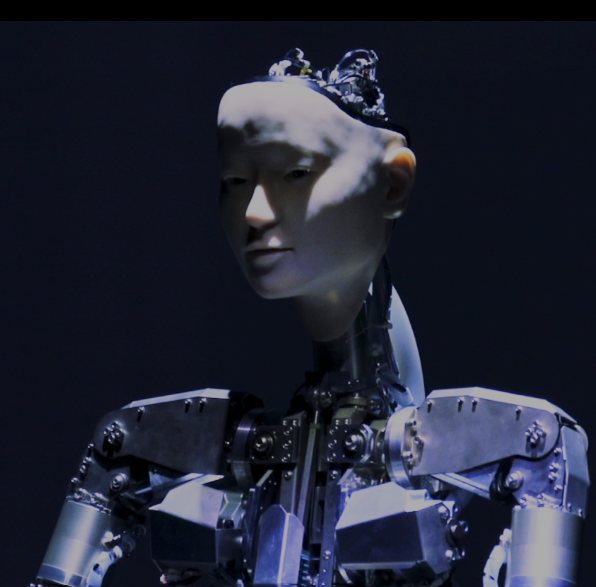
That took me to a collaboration with Professor Takashi Ikegami’s group at the University of Tokyo, and to a machine called Alter.
Alter is an android developed jointly by Ikegami’s lab at Tokyo and Hiroshi Ishiguro’s lab at Osaka. Only its face, neck and forearms carry prosthetic skin; the rest is exposed machinery, driven by pneumatic actuators. It looks unsettling, and deliberately so; it was never built to pass as human.
What makes it remarkable is what’s underneath. Alter’s movements are not pre-programmed. There’s no animation library, no choreographed routine. Its motion comes from a central pattern generator, a system modelled on the rhythmic circuits in the human spinal cord that produce walking without conscious thought, coupled to a network of around a thousand simulated neurons firing in real time, responding to sensors that read sound, temperature, humidity and proximity.
The lab wasn’t asking “can we make a robot do a task.” They were asking a properly ALife question: can a machine acquire a sense of being alive, and what would that even mean? Alter has been exhibited publicly, has composed music and has conducted performances. Watching people react to it is arguably the actual experiment.
What I worked on
My research added a module to this system, and the idea behind it was simple to state and hard to build.
Living things don’t make decisions from a clean internal state. They make them from a body that is constantly, restlessly regulating itself: temperature, glucose, pH, oxygen. Homeostasis. And crucially, that regulation is noisy. Biology is not deterministic. The fluctuations of a living body leak into its behaviour.
I think that’s a real part of what we’re gesturing at when we say gut feeling. Not mysticism, just the fact that decisions in an organism are made by a system that is also busy staying alive, and that the noise of staying alive colours the choice.
So I built Alter a source of biological restlessness: a homeostasis-inspired module using microbial fuel cells (live bacterial cultures generating electrical signals) feeding genuine biological variability into the android’s decision-making. Not a random number generator. Not rand(). An actual living process, with its own rhythms and its own moods, wired into a machine’s choices.
A little of nature’s randomness, given a vote.
Why this matters more now, not less
It would be easy to file all of this under “charming pre-history.” It isn’t.
In 2023, Ikegami’s group published work grounding GPT-4 in Alter3, using a large language model to generate the robot’s spontaneous motion directly from language, with no explicit programming for each of its 43 axes. Ask it to strike a selfie pose or pretend to be a ghost, and it works it out. Zero-shot. You can then correct it verbally and it adjusts.
Think about what that is. A field that spent forty years asking what is the minimum recipe for lifelike autonomy now has a genuinely new ingredient to test: a model trained on the accumulated traces of how humans describe living.
Meanwhile the AI conversation has been swallowed almost entirely by capability. Benchmarks, parameters, evals, agents that can book flights. All important. But it’s a narrow slice of a much older question, and I think we’re going to need the other slice sooner than people expect.
Because as we build systems that act autonomously in the world, the questions stop being how well does it perform and start being: what does it mean for this thing to have a body? To have preferences? To maintain itself? To be an agent rather than a tool?
Artificial Life has been sitting with those questions since 1987, patiently, in a room full of biologists and philosophers and animators nobody was paying attention to.
I went looking for artificial intelligence. I found a field asking what it means to be alive at all.
I have no regrets about the detour.
Sources
- Langton, C. G. (ed.) (1989). Artificial Life: The Proceedings of an Interdisciplinary Workshop on the Synthesis and Simulation of Living Systems, Los Alamos, 1987. Addison-Wesley.
- Scientific American. “Life Evolves. Can Attempts to Create ‘Artificial Life’ Evolve, Too?” https://www.scientificamerican.com/article/life-evolves-can-attempts-to-create-artificial-life-evolve-too/
- Gardner, M. (October 1970). “Mathematical Games: The fantastic combinations of John Conway’s new solitaire game ‘life’.” Scientific American 223(4), 120–123. https://web.stanford.edu/class/sts145/Library/life.pdf
- Reynolds, C. W. (1987). “Flocks, Herds, and Schools: A Distributed Behavioral Model.” SIGGRAPH ‘87. https://www.red3d.com/cwr/boids/
- Hutchison, C. A. III, et al. (2016). “Design and synthesis of a minimal bacterial genome.” Science. https://doi.org/10.1126/science.aad6253
- J. Craig Venter Institute. First Minimal Synthetic Bacterial Cell. https://www.jcvi.org/research/first-minimal-synthetic-bacterial-cell
- Alter android. Development by Ikegami Lab (University of Tokyo) and Ishiguro Lab (Osaka University); CPG and neural network architecture. https://www.ntticc.or.jp/en/archive/works/alter/
- Alternative Machine Inc. Alter3 project overview. https://alternativemachine.co.jp/en/project/alter3/
- Yoshida, T., Masumori, A., Ikegami, T. (2023/2025). “From Text to Motion: Grounding GPT-4 in a Humanoid Robot ‘Alter3’.” arXiv:2312.06571; Frontiers in Robotics and AI. https://arxiv.org/abs/2312.06571