

Picture a robot.
I’ll wait.
I’d bet money on what you saw. A metal humanoid, roughly person-shaped, walking with that slightly drunk gait, probably in a promotional video, probably about to fail at picking up a mug. Or an industrial arm in a car factory, swinging welds in a cage. Maybe a Roomba, if you’re feeling domestic.
That image isn’t wrong, exactly. It’s just about one per cent of the field. And I know that because I spent a year at the Bristol Robotics Laboratory, and on my first proper walk around the place, almost nothing I saw matched the picture in my head.
BRL is a joint venture between the University of Bristol and UWE Bristol, and it’s the largest robotics research facility in the UK. What that means in practice is that you can walk down one corridor and pass through four entirely unrelated conceptions of what a robot even is.
Let me take you on that walk.
Stop one: the robots that aren’t rigid
The first thing that broke my mental model was soft robotics.
The whole discipline starts from an observation so obvious it’s easy to miss: almost nothing in nature is rigid. Octopuses have no skeleton. Elephant trunks have no joints. Your tongue is a boneless hydraulic marvel that can produce every sound in every human language. And yet we built a century of robotics out of metal, motors and hinges, the least biological materials available.
Bristol’s SoftLab, led by Professor Jonathan Rossiter, works on the opposite premise: robots made of smart materials, reactive polymers and compliant structures that bend rather than pivot. Because they’re soft, they’re inherently safe to put on or near a human body.
Some of what has come out of that group sounds like science fiction until you see it working:
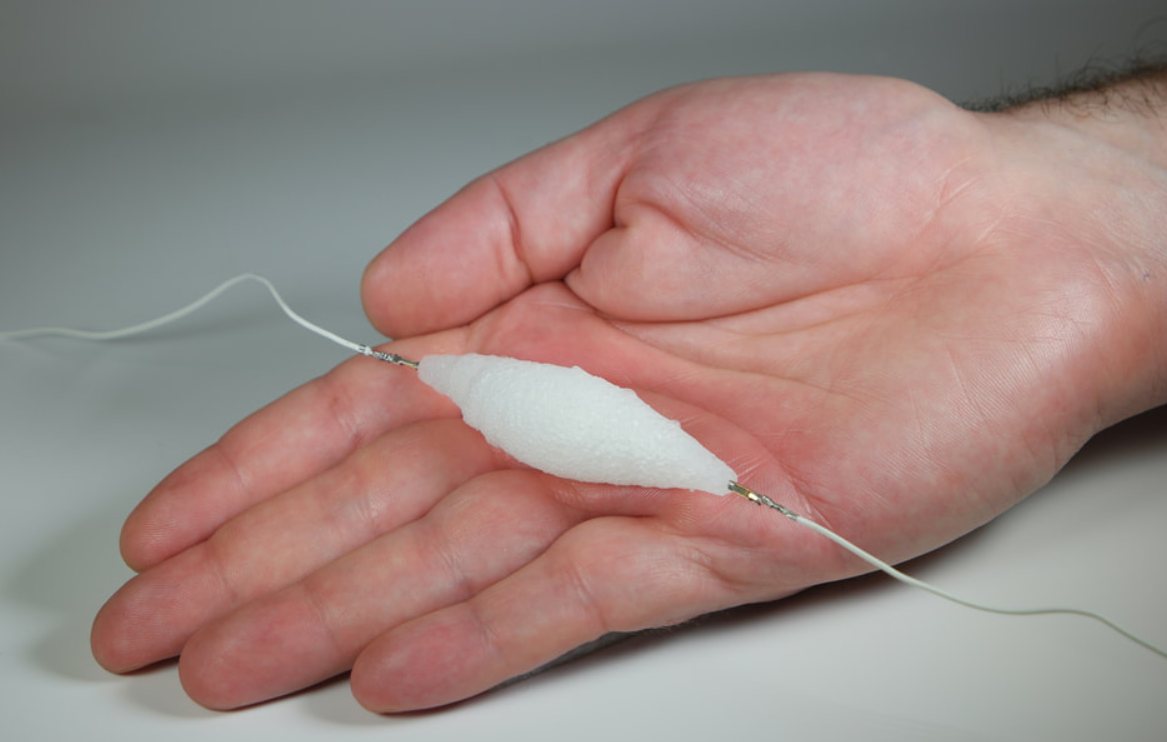
- Artificial muscles: actuators that contract like tissue rather than rotate like a motor.
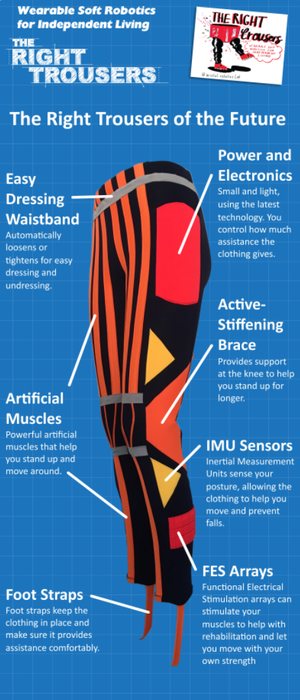
- The Right Trousers: a multi-institution project building wearable soft robotic clothing to help people with reduced mobility stand, walk and climb stairs. Not an exoskeleton bolted over your legs. Trousers.
- Biodegradable and edible robots. Yes, edible. Think about what that unlocks: a robot you swallow to deliver a drug or take a reading, which then simply dissolves. Or an environmental sensor you scatter across a landscape that rots away when its job is done instead of becoming e-waste.
There’s a phrase that stuck with me from that side of the lab: softness is not a compromise, it’s a capability. Rigidity is what you choose when you want precision and repeatability. Compliance is what you choose when you want to survive contact with an unpredictable world. Nature made that trade centuries before we did.
Stop two: the robots learning to feel
Here’s a question that sounds trivial and isn’t: how does a robot know it’s holding something?
Vision gets almost all the attention in AI. Touch gets almost none. But try picking up a paper cup with your eyes closed: easy. Now try it with your hand numbed. Suddenly you’re crushing it or dropping it. Almost all of the fine control in your hands comes from touch, not sight.
Professor Nathan Lepora’s Tactile Robotics group at BRL works on exactly this gap. Their signature creation is the TacTip, a 3D-printed tactile fingertip, biomimetic in the truest sense. Inside the soft skin sit little pins modelled on the dermal papillae in human fingertips. A camera watches those pins move. Machine learning turns the pin movements into an understanding of texture, edge, slip, and shape.
What I loved about this group is how deep the biology goes. They don’t just build the sensor; they apply computational neuroscience so the algorithms process touch the way a brain processes touch. It isn’t imitation of the hand. It’s imitation of the whole loop from skin to cortex.
If you’ve ever watched a humanoid demo fumble a grip and thought how is this still so hard: this is the answer. The hard part was never the fingers. It was the feeling.
Stop three: the robot that eats
And then there’s the one that everybody remembers.
At the Bristol BioEnergy Centre, Professor Ioannis Ieropoulos has spent over two decades building the EcoBot family: robots powered by microbial fuel cells. Not batteries. Not solar. Live bacteria, digesting organic matter, producing electricity as a by-product of simply being alive.
Across the generations, EcoBots have been fed rotten fruit, grass clippings, prawn shells, dead flies, wastewater, sludge, and urine. Urine turned out to be extraordinary fuel: chemically active, rich in nitrogen, balancing the pH and boosting conductivity, and by Ieropoulos’s own comparison, at least three times better than the alternatives they’d tried.
EcoBot-III took the logic to its natural conclusion. It gathers its own food and water, does its job, and then gets rid of its own waste into an onboard tray. Ieropoulos has described it, memorably and accurately, as a robot that craps into its own litter tray.
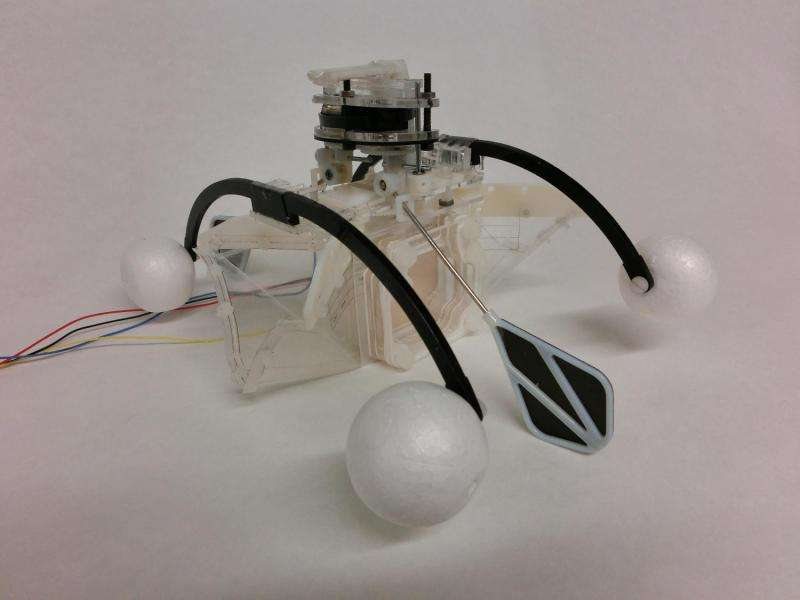
Then there’s the Row-bot, which I still think is one of the most elegant machines I’ve ever encountered. It’s modelled on the water boatman, an aquatic beetle that swims through nutrient-rich dirty water. When the Row-bot is hungry, it opens a soft robotic mouth and rows forward, filling a microbial fuel cell “stomach” with filthy water. Then it closes its mouth and digests. The energy it generates exceeds the energy it spends rowing, which means, in principle, it never has to stop.
Sit with that. An artificial organism with a mouth, a stomach and a metabolism, that gets hungry, feeds itself, and gets its energy from pollution.
And this isn’t only a curiosity. The same microbial fuel cell technology became Pee Power, funded by the Gates Foundation, which has been deployed to light toilet blocks at schools in Uganda and Kenya. The lab that built the pooping robot also built infrastructure that makes it safer for girls to use a school toilet after dark.
Stop four: robots that only make sense in the plural
Professor Sabine Hauert works on swarm engineering, and swarm robotics inverts almost every instinct you have about machine design.
A single swarm robot is deliberately stupid. It has limited sensing, limited communication, no map of the world and no idea what the group is doing. The intelligence isn’t in any unit. It’s in the interaction rules. Get the local rules right and the useful behaviour emerges at the group level, with nobody in charge.
The applications run in wild directions. Hauert’s work extends into nanomedicine: swarms of nanoparticles navigating the body to deliver treatment to a tumour. Same mathematics as a flock of starlings. Radically different stakes.
And alongside all of this, BRL runs research in aerial robotics and drone safety, driverless vehicles, medical and rehabilitation robotics, assisted living, human-robot interaction, machine vision, and formal verification for robot safety, the unglamorous but essential business of proving a machine will not hurt someone.
There is even a group, at UWE’s Unconventional Computing Laboratory, attaching electrodes to fungi to work out whether mycelium is computing something. I’ll come back to that one; it deserves its own story.
Why the narrow picture actually costs us something
So why does it matter that most people picture a metal person?
Because the picture shapes what gets built, funded, admired and reported. Right now the public imagination of robotics is dominated by humanoids, and humanoids are genuinely hard, genuinely expensive, and genuinely underwhelming in most demos. When the humanoid stumbles, the average viewer concludes robotics is overhyped and moves on.
Meanwhile a beetle-shaped machine is quietly demonstrating energy autonomy from pond scum. A pair of trousers is helping someone climb their own stairs. A 3D-printed fingertip is teaching us how touch actually works. None of it looks like a robot. All of it is robotics.
The field isn’t a race to build a mechanical human. It’s a much stranger, older question: what can a machine be? Rigid or soft, singular or swarmed, powered by lithium or by bacteria, shaped like a person or a beetle or a sheet of fabric or nothing you have a word for.
I walked into that building expecting machines. I walked out thinking about metabolism, touch, emergence, and what counts as a body.
That’s a much better question than when will the humanoid work.
I studied for my MSc in Robotics at the University of Bristol, based at the Bristol Robotics Laboratory. Everything above is research I encountered there or that the lab has published publicly. Any errors of emphasis are mine.
Sources
- Bristol Robotics Laboratory. About / research areas. https://www.bristolroboticslab.com/about-us
- Tactile Robotics Group, University of Bristol (Prof. Nathan Lepora). TacTip and biomimetic touch. https://www.bristol.ac.uk/research/groups/tactile-robotics/
- Bristol SoftLab / Soft Robotics Group (Prof. Jonathan Rossiter). https://www.bristol.ac.uk/research/groups/softlab/
- The Right Trousers project. Wearable soft robotics for independent living. https://therighttrousers.com/members/
- Ieropoulos, I. et al. EcoBot family and microbial fuel cells. Scientific American, “Human Waste-Powered Robots May Be Future of Machines.” https://www.scientificamerican.com/article/human-waste-powered-robot/
- Philamore, H., Rossiter, J., Stinchcombe, A., Ieropoulos, I. (2015). “Row-bot: An energetically autonomous artificial water boatman.” IEEE/RSJ IROS 2015. https://doi.org/10.1109/IROS.2015.7353924
- University of Bristol news. Row-bot. https://www.bristol.ac.uk/news/2015/november/row-bot.html
- Pee Power / Urine-tricity, Gates Foundation-funded deployments in Uganda and Kenya. https://www.spark-conversations.com/episode-54-pee-power-ioannis-ieropoulos
- Swarm Robotics at BRL (Prof. Sabine Hauert). https://www.bristolroboticslab.com/swarm-robotics