

Let’s start by correcting something almost everyone gets wrong.
A mushroom is not an organism. A mushroom is a fruit.
The actual organism is underground: a network of microscopic threads called hyphae, branching and fusing and spreading through soil, wood, leaf litter, sometimes across hundreds of metres. That network is the mycelium. The mushroom is just the bit it pushes up into the air when it wants to release spores. Picking a mushroom is closer to picking an apple than to felling the tree.
So when you walk through a forest, you’re walking on the roof of something. And that something is far more interesting than the field it belongs to has ever been given credit for.
The oldest partnership on land
Here’s the fact that reframed the entire planet for me.
Plants did not colonise land alone. They couldn’t have.
Around 450 to 500 million years ago, the first plants moved out of water onto bare rock and mineral soil, an environment with no organic matter, no nutrient reservoir, and no way to hold water. These early plants had no roots. Roots hadn’t been invented yet.
What they had instead was a deal with a fungus.
The fungus threaded its hyphae through the soil (far thinner and far longer than any root, reaching into pores no root could enter) and pulled in phosphorus, nitrogen and water. In exchange, the plant sent down sugar made from sunlight. That partnership is called mycorrhiza, from Greek for “fungus-root,” and the fossil record shows it in 450-million-year-old plant tissue.
Some scale for that: wood as a tissue is roughly 380 million years old. The fungal partnership predates wood by about 70 million years. Before plants invented bark, or seeds, or the upright stem, they had already invented the deal with the fungus.
It never stopped. Today the overwhelming majority of land plants still run on it. Pull a redwood out of the ground and you are looking at half an organism; the other half is fungal, underground, and busy.
This is the point Merlin Sheldrake’s Entangled Life makes better than anyone: fungi aren’t a curious sideshow to the story of life on land. They’re a load-bearing wall. Sheldrake’s book is the best entry point I know into this world, and I’d recommend it to anyone who finds this article interesting; it goes far deeper than I can here.
Ecologists have a nickname for the mycorrhizal networks that connect whole plant communities underground: the wood wide web. Nutrients move through it. Possibly signals do too. The extent and the mechanics are genuinely, actively contested science, which is exactly why the next part is so interesting.
The question: is anything being said?
Fungi have no neurons. No brain, no nervous system, nothing resembling one.
And yet, fungi produce spikes of electrical potential.
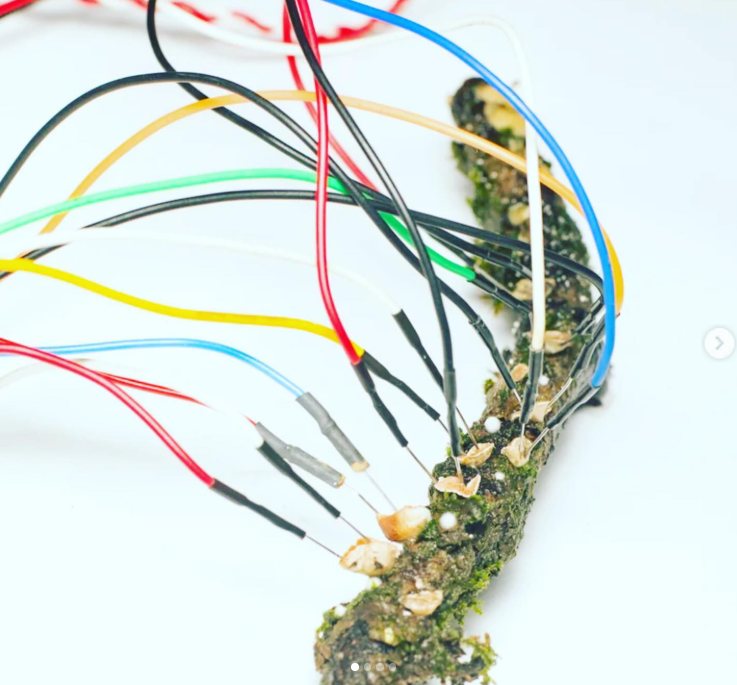
This shouldn’t be as surprising as it sounds. Spiking is usually treated as the signature of a nervous system, but almost every creature without a nervous system does it too: protozoa, hydrozoa, slime moulds, plants. Fungi are on that list. Insert a pair of differential electrodes into a substrate colonised by mycelium and you can record oscillations in electrical potential.
The obvious question, the one that’s hard to ask without sounding ridiculous, is whether any of it means anything.
Professor Andrew Adamatzky, who runs the Unconventional Computing Laboratory at UWE Bristol, decided to ask it properly.
The experiment
Adamatzky’s 2022 paper in Royal Society Open Science is titled, with no hedging whatsoever, “Language of fungi derived from their electrical spiking activity.”
He inserted differential electrodes into four species and recorded continuously:
- Ghost fungi (Omphalotus nidiformis)
- Enoki (Flammulina velutipes)
- Split gill (Schizophyllum commune)
- Caterpillar fungi (Cordyceps militaris)
What came back was, first of all, weirdly slow. Fungal spikes last between one and 21 hours, with amplitudes between 0.03 and 2.1 millivolts. A neuron fires in milliseconds. If fungi are talking, they’re talking on a timescale where a single syllable can take most of a working day.
The spiking turned out to be species-specific: each species had its own signature. Enoki produced a rich spread of low-frequency irregular oscillations; split gill swung from low to high amplitude and was among the fastest-spiking species Adamatzky had ever recorded.
And the spikes clustered. Not evenly, not randomly: in trains, groups separated by quiet.
That clustering is what let him do the thing that made headlines. If you treat a cluster as a word, you can run linguistic analysis on it. So he did.
The results:
- A fungal “lexicon” of up to 50 words, with a core vocabulary of the most frequently used sitting at 15 to 20.
- Average fungal “word length” across the four species: 5.97. For comparison, English averages 4.8 and Russian 6.
- Schizophyllum commune (the split gill) generated the most complex “sentences” by algorithmic complexity measures.
The distribution of fungal word lengths matched the distribution in human languages.
Now the part good science writing doesn’t skip
That result is thrilling. It is also not proof that fungi have language, and the most important voice saying so is Adamatzky’s own.
He has stated the alternative himself, plainly: there is another option, which is that they are saying nothing. Growing mycelium tips carry an electrical charge. When a charged tip passes between a pair of electrodes, you record a spike in potential difference. The pattern could be the fungus moving, not the fungus speaking.
Mycologists have pushed back too. Dan Bebber at the University of Exeter, who has co-authored previous work on these electrical signals, noted that the rhythms in this paper occur at a similar frequency to nutrient pulses his own group had already documented, and has called the reading of these signals as language somewhat overenthusiastic, something that would require far more testing of critical hypotheses first.
That’s a fair objection, and it’s the right one. The spikes could be metabolism. They could be transport. They could be the electrical exhaust of an organism going about its business with nothing communicative about it at all.
But here’s what nobody disputes: the spikes are not random. They have structure, they differ reliably between species, and they change in response to mechanical, chemical and optical stimulation. Something is being organised. We just don’t know what, or for whom.
I find that far more exciting than a tidy answer would be. This is what an open scientific question actually looks like from the inside: a real signal, several competing explanations, and not enough evidence yet to choose.
Fungal computers, seriously
There’s a second thread here that gets less attention than the language headline, and it may end up mattering more.
The Unconventional Computing Laboratory exists to ask whether computation has to happen in silicon. If a mycelium network transmits and modulates electrical signals across a branching, adaptive, self-repairing topology, then that is, structurally, not a bad description of a computer. Or at least of a reservoir: a physical system complex enough that you can feed signals in, let its internal dynamics do nonlinear work, and read useful answers out.
Researchers are actively building on this. Recent work has modelled mycelium as a computational medium for reservoir computing, and other groups have built memristive circuits specifically to emulate mycelium’s electrical activity in hardware.
Think about what a living computational substrate would mean. It grows itself. It repairs itself. It runs on organic waste. It’s biodegradable by definition. It’s also maddeningly slow, and hours-long spikes are not going to trouble a GPU.
But “slow and alive” is a genuinely different point in the design space from “fast and mined.” Some problems might want it.
Why I nearly spent years on this
I have a personal stake in this story.
After my MSc in Robotics at Bristol, I put together a research proposal to work on exactly this: studying the fungal intelligence by decoding the patterns of mycelium networks. Trying to get at the structure of whatever fungi are doing with those signals.
The proposal was accepted.
I couldn’t secure the funding, and I had to choose a different path. That’s the unglamorous ending a lot of research stories have, and I’ve made peace with it, but I’ve never stopped following the field, and writing this has reminded me exactly why it caught me in the first place.
The reframe
The thing I want to leave you with isn’t “mushrooms can talk.” That would be overclaiming, and the researchers themselves are more careful than the headlines were.
It’s this.
We have a very specific idea of what intelligence looks like. Centralised. Fast. Neural. Housed in a skull. It’s the only version we’ve had a good look at, so we made it the definition.
Fungi have no brain, no centre, and no speed. They have been running the nutrient economy of every forest on Earth for 450 million years. They solve routing problems, allocate resources across networks, negotiate trades with organisms from an entirely different kingdom, and respond to injury and opportunity, all with a distributed architecture that has no equivalent of a head.
Whether or not the electrical spikes turn out to be language, the question is the right one to be asking. Because if intelligence is something a network can do without a brain, then we have been looking for it in exactly one place and calling that place the whole world.
There’s an internet under your feet. We just don’t speak the protocol. Yet?.
Further reading & sources
- Adamatzky, A. (2022). “Language of fungi derived from their electrical spiking activity.” Royal Society Open Science 9(4): 211926. https://doi.org/10.1098/rsos.211926 (preprint: https://arxiv.org/abs/2112.09907)
- UWE Bristol. Unconventional Computing Laboratory research announcement. https://blogs.uwe.ac.uk/research-business-innovation/uwe-bristol-academic-researches-the-language-of-fungi-derived-from-their-electrical-spiking-activity/
- Smithsonian Magazine. “Mushrooms May Communicate With Each Other Using Electrical Impulses” (includes Dan Bebber’s critique). https://www.smithsonianmag.com/smart-news/mushrooms-may-communicate-with-each-other-using-electrical-impulses-180979889/
- ScienceAlert. Coverage and Adamatzky’s own caveats. https://www.sciencealert.com/fungi-communicate-with-patterns-that-look-uncannily-like-our-own-speech
- Sheldrake, M. (2020). Entangled Life: How Fungi Make Our Worlds, Change Our Minds and Shape Our Futures. Bodley Head.
- Rich, M. K. et al. Phylogenomic evidence that plants colonised land together with fungal symbiotic partners. https://pubmed.ncbi.nlm.nih.gov/37254793/
- Bonfante, P. & Genre, A. “The Mutualistic Interaction between Plants and Arbuscular Mycorrhizal Fungi,” Microbiology Spectrum. https://doi.org/10.1128/microbiolspec.funk-0012-2016
- Tompris, I. et al. (2025). “Mycelium as a computational medium: a framework for growth modeling towards reservoir computing.” Natural Computing. https://doi.org/10.1007/s11047-025-10040-x